
The Antique Dutch Black Frame
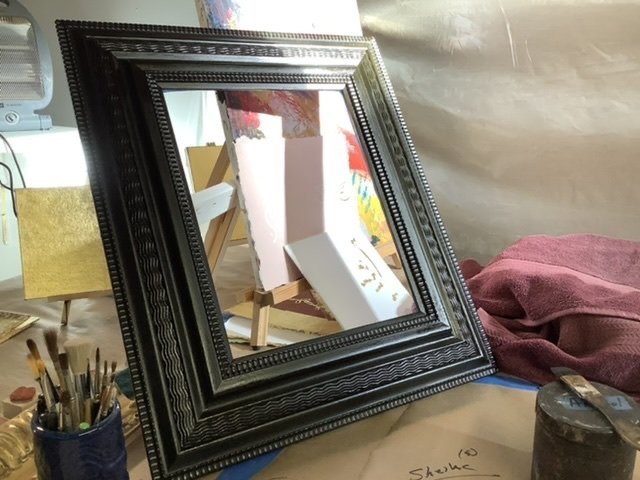
From Rembrandt to Vermeer
The Classic 17th c Dutch Black Frame for Contemporary Works Of Art.
Creating The Dutch Black Frame Finish
The predilection for frame finishes during 17th century Holland steered away from the opulence of the gold leaf gilded frames being produced at the time in France and Italy. Tastes tended more towards simpler, earthier tones as seen on the frames of Vermeer and Rembrandt and as shown on Rembrandt's early self-portrait which hangs today at the Rijksmuseum in Amsterdam. Many of the early, ripple-style frames, however, were actually manufactured in countries such as Germany and Spain and thought of as 'Dutch' because of their extensive use in Holland.
Frames were often painted black in a form of ebonizing, due to the limited availability and cost of ebony. Considering the wide use of this approach this Classic 17thc Black Frame Finish has come to be known in certain circles as Dutch Black and remains a popular choice for contemporary works of art.
Creating The Dutch Black Frame Finish
Charles Douglas has spent twenty-five of his forty years gilding perfecting the Dutch Black Finish and uses a variety of approaches. The method used to achieve a deep, antique umber-black tone involves painting a custom blend of several colors of casein paint onto finely sanded wood. Numerous layers of ruby shellac are brushed or padded on, depending on the shape of the frame profile, hand-rubbed between layers.
His Online Class: Creating The Antique Dutch Black Finish is offered several times throughout the year and takes students through each step of the process from sealing the wood frame and preparing the tri-color mix of Casein paint to applying the required eight coats of custom-mixed Ruby Shellac and extensive hand-rubbing. Pumice powder, steel wool, and rottenstone are among his treasured materials. A final addition of mordant gilding in 6k white gold leaf or 23k gold leaf along the inner edge of the frame with a wash of either black or raw umber casein sets off the understated elegance of this Classic Black Frame Finish.
For a somewhat more contemporary variation he also developed his version of what he refers to as Early American Black, based on original techniques used in in both America and Holland during the 17th and 18th centuries. This exquisite Finish combines lampblack pigment and ruby shellac, prepared in his studio from shellac flakes and alcohol. As many as ten coats are applied, each layer hand-rubbed. Early American cabinetmakers referred to this finish simply as Black Varnish.
The use of Dutch and Early American black frames offer an excellent choice on certain works of art such as portraits in oil as well as for mirrors. The overall tone of the Finish can be represented as modern, smooth and free of distress, or enhanced with various antiqued effects, a vocabulary achieved through added mediums including the deposit of gray and umber pigments in crevices, washes, and rubbing-through to the wood on high points to signify age. Often, a simple and occasional rub-through to the wood and moderate distress provides the most attractive and sophisticated finish.
A Touch Of Gold
An added touch of gilding along the inner edge of certain frame profiles can provide an appropriate segue for certain works of art, often toned with either a black wash over silver or white gold leaf or raw umber over 23k gold to soften the transition from frame to art. ~
For further reading on the history of the Dutch Black Finish, the style of Dutch Ripple Moulding and the framing of Vermeer’s paintings in particular visit Essential Vermeer.
Online Classes
For those interested in exploring the Online Class: Creating the Antique Dutch Black Finish Visit the section Book a Gilding Class to Register. Charles will follow up with a Materials list and helpful links upon registration.